


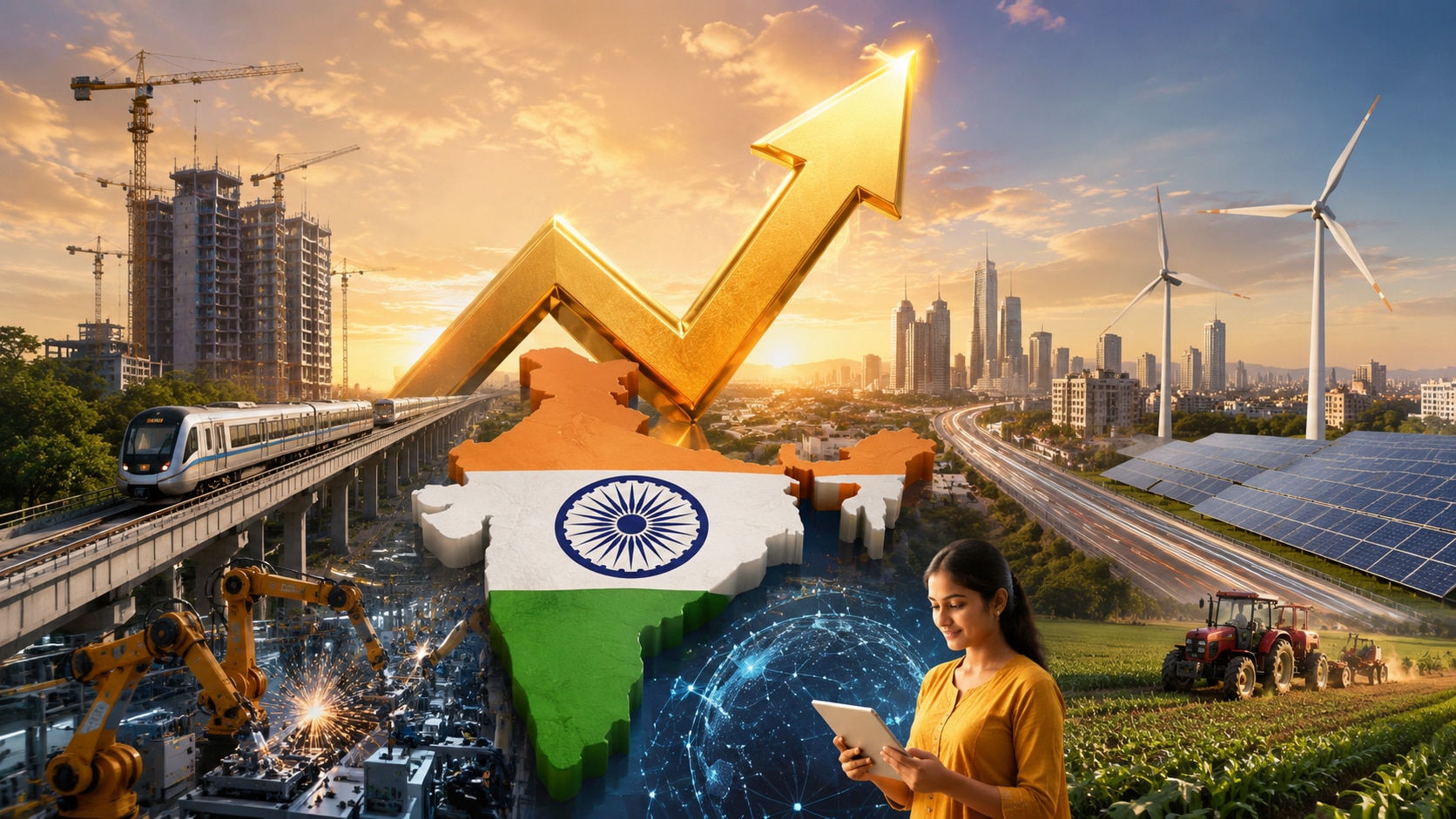
New Delhi: In a matter of good news for the country, India’s economy is projected to expand by 7 percent in fiscal 2026–27 following a stronger-than-expected 7.8 percent growth rate in FY26, according to an S&P Global-Crisil report released Wednesday. Titled “India Forward: Reimagining Growth,” the report emphasizes that India’s domestic economic drivers provide significant resilience against global headwinds and high US tariffs. While growth is expected to moderate as the economy matures into its next development phase, the report highlights that India remains well-positioned to sustain long-term expansion if macroeconomic resilience is effectively leveraged.
Yann Le Pallec, President of S&P Global Ratings and Chairman of the Board for Crisil, said India has a significant opportunity to build on its economic resilience through continued infrastructure development, greater competitive federalism, deeper capital markets and stronger financial intermediation.
The report highlighted that India’s stronger-than-expected growth underscores the resilience of domestic demand and the economy’s ability to navigate an increasingly uncertain global landscape. It added that the country’s next phase of growth will depend on sustaining investment momentum and strengthening key economic institutions.
On the geopolitical front, the study suggested that India is increasingly positioning itself as a leading power rather than a balancing power in global affairs. It said the country’s evolving foreign policy strategy is likely to involve selective cooperation with major powers while deepening engagement with emerging economies.
The report also flagged energy security as a key concern following disruptions in supplies passing through the Strait of Hormuz. According to S&P Global Energy President Dave Ernsberger, India has faced a 20 per cent reduction in crude oil supplies, a 12 per cent decline in LPG availability and a 16 per cent drop in LNG flows due to the continuing disruption.
He noted that economic resilience and energy security remain critical as the country responds to the supply shock. More than half of India’s crude oil imports pass through the Strait of Hormuz, making it one of the countries most exposed to disruptions in the strategic waterway.
The report called for greater diversification of supply sources and the creation of strategic reserves for crude oil, refined products and natural gas to strengthen long-term energy security.




For breaking news and live news updates, like us on Facebook or follow us on Twitter and Instagram. Read more on Latest Business News on India.com.