


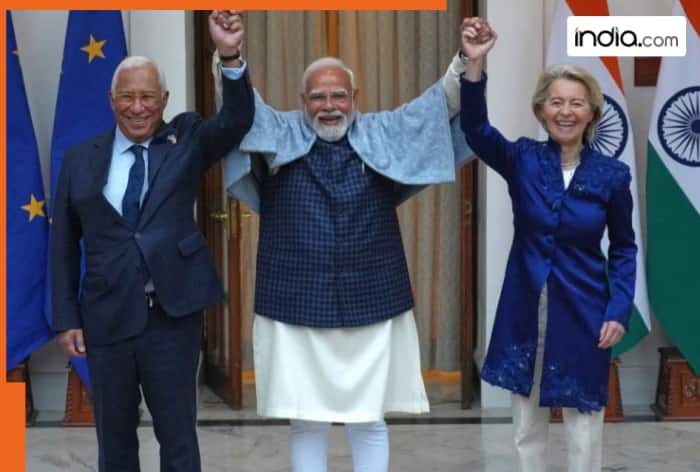
India-EU Trade Deal: India and the European Union have signed the historic mega free-trade agreement (FTA) at a high-level summit in New Delhi on Tuesday, marking a major development after nearly 20 years of talks. Prime Minister Narendra Modi hosted European Commission President Ursula von der Leyen at the summit, which is also finalising the defence partnership. European Council President Antonio Costa also attended the summit. These agreements are expected to support a wider India–EU strategy to deal with the continuously changing global politics caused by recent US trade policies.
On Monday, Commerce Secretary Rajesh Agrawal informed that discussions on the long-pending free trade agreement between India and EU was successfully concluded.
“Negotiations have been successfully concluded. The deal has been finalised,” Agrawal said.
He further state that the pact is forward-looking from India’s perspective and it would help integrate New Delhi more closely with European economy.
“A successful India makes the world more stable, prosperous and secure, and we all benefit,” Von der Leyen said on X.
Also Read: The Golden Ticket: Why the India-EU Trade Deal Matters More Than You Think
According to Agrawal, the crucial free trade agreement is expected to come into force early next year. Notably, the historic pact still require approval from the Union Cabinet in India and the European Parliament. This process could take several months.
Commerce and Industry Minister Piyush Goyal has termed it “the mother of all deals”, reflecting its strategic significance. Talks between India and EU for the agreement started in 2007, making it one of New Delhi’s longest-running trade talks.
The agreement is expected to bring duty-free or preferential access to Indian exports, specially labour-intensive sectors like – textiles, chemicals, gems and jewellery, electrical machinery, leather and footwear.
Currently, the average tariff imposed by the EU on Indian goods is about 3.8 percent, however, on duties on labour-intensive products its 10 percent. India’s average tariff on EU goods is 9.3 percent, which also includes duties on automobiles, plastics, chemicals and pharmaceuticals.
Under FTA agreement, India and EU are both expected to reduce import duties on 90 percent of traded goods. The pact also includes ease on services such as telecommunications, transport, accounting and auditing.






For breaking news and live news updates, like us on Facebook or follow us on Twitter and Instagram. Read more on Latest Business News on India.com.

