



Anirudha Yerunkar
He is working as Chief Sub Editor with India.com and has experience in Digital Media and YouTube. He has covered Budget 2023, 2024, 2025 for reputed channels. Born and brought up in Mumbai, he is an e ... Read More


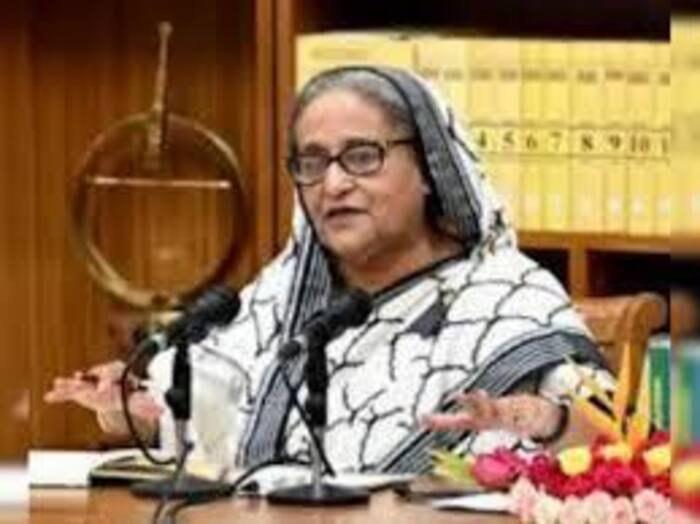
Bangladesh Prime Minister Sheikh Hasina on Monday resigned and left the country, several news reports said amid massive protests against her government that claimed more than 106 lives in the last two days.
However, there was no official confirmation about her quitting and leaving Dhaka.
BBC reported that Hasina left on a helicopter for Agartala in Tripura. The Associated Press said she has resigned but gave no other details. However, the Ministry of External Affairs or local officials in Agartala refused to confirm the report. Tripura Home Secretary P.K. Chakravarty told PTI “we have no such information.
बांग्लादेश अब पाकिस्तान की राह पर? दिनदहाड़े शेख हसीना का तख्तापलट हो गया#BangladeshViolence #Bangladesh #SheikhHasina #BangladeshNews | @ShobhnaYadava pic.twitter.com/mC9HQoupcW
— Zee News (@ZeeNews) August 5, 2024
With the situation in the country fluid and uncertain, the Bangladeshi army chief was said to address the nation later Monday.
Sheikh Hasina had led the country’s economic progress in the last several years. After Bangladesh’s independence in 1971, the country had undergone a major economic transformation, Sheikh Hasina made it from world’s poorest nations to one of the fastest-growing economies.
After the resignation by Sheikh Hasina, the country’s Economy is going to face major challenges. Many economic activities were already halted after a nationwide protest. Now under the new military rule Bangladesh will face major challenges in upcomings days as mentioned below.
Bangladesh Political Crisis : शेख हसीना ने पीएम पद से दिया इस्तीफा, देश छोड़ा, पीएम आवास में घुसी भीड़
बांग्लादेश मीडिया की रिपोर्ट के मुताबिक शेख हसीना अपनी छोटी बहन शेख रेहाना के साथ देश छोड़ा है. उनके पीएम आवास छोड़ने के कुछ समय बाद प्रदर्शनकारियों ने गणभवन पर कब्जा कर लिया… pic.twitter.com/H9S6RZhEr0
— Zee News (@ZeeNews) August 5, 2024
Sheikh Hasina Resigns: Top Challenges In Front Of Bangladesh’s Economy
Inflation: Despite a global decrease in inflation rates, Bangladesh had maintained around 10 percent inflation in 2023. But after the current political instability it led to hikes in food and fuel prices. Already certain areas were affected after the long protest in the country. Now supply chain fuel, consumer products may get affected due to the nationwide protest which can increase the inflation.
Impact On Banking Sector: Countries largest private bank, Islami Bank had sought for financial assistance in 2022 to restore depositor trust. There was already a crisis due to loan fraud, capital flight and bureaucratic corruption.
Energy sector: Bangladesh had increased 80 percent electricity generation capacity from 5 GigaWatts (GW) in 2009 to 25.5 GW in 2022. But the Plant Load Factor (PLF) , was low for Bangladesh in 2022.
Less FOREX In Hands: FOREX was already under depletion and Bangladeshi Taka was also weakened. Foreign reserves had fallen from US$ 39 billion to below US$ 32 billion in six months and a 27-percent depreciation of the Taka was seen in 2023. After the resignation of Sheikh Hasina over the protest, export & import activities can be halted and will adversely impact on foreign currencies in hand. It will also reduce local currency valuation in the international market amid political instability in the country.
Export Diversification Challenge: Bangladesh was already facing challenges in its export diversification. It was majorly relying on the textile and Ready-Made Garments (RMG) sector. More than 84 percent of Bangladesh’s total export earnings in 2019–2020 were only from garment exports. After the ongoing protest in the country, the Garment industry is also widely impacted in some parts & export may also get halted in future.
Balance of payments: As the country already had import-export mismatch it impacted on its current account and overall balance of payments (BOP). It then impacted on countries’ fiscal deficits as exports were reduced but imports were increased.
Tax administration: Bangladesh has a tax-GDP ratio of 8 percent which is lower than many lower-middle-income countries. Tax administration in Bangladesh was facing challenges of corruption, hence it affected the revenue in the hand of the government. Now as there is no formal government, the tax system which was already developed in recent years may not progress.
Climate Change: The country is already grappling with the threat of climate change, due to rising sea levels, urbanisation, and deforestation. In May 2020 Bangladesh faced its most powerful Cyclone Amphan which impacted over a million people across nine districts in the country & resulted in losses amounting to approximately US$ 130 million.
(With Inputs From PTI)

For breaking news and live news updates, like us on Facebook or follow us on Twitter and Instagram. Read more on Latest Business News on India.com.