


The Hyundai Sonata has been around for quite a while – but apart from the good start it got early on, thanks to the Jaguar-inspired design, it never quite managed to rake up good sales figures. It was succeeded by the Sonata Transform, which tried hard too, but failed miserably! Now Hyundai is back with one more model – and though it is called the i45 in the global market, Hyundai has decided to stick to the ‘Sonata’ model name, in spite of the ‘i’ moniker being so successful for the brand.
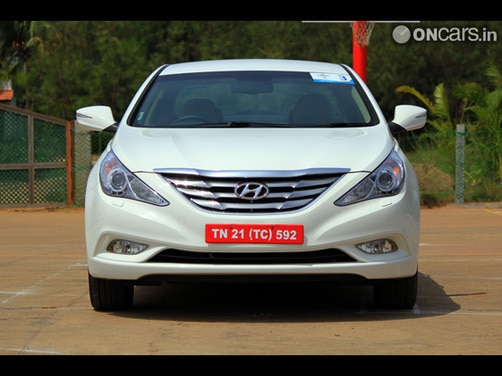
As you would expect, the new Sonata gets its novelty largely because of the Fluidic design philosophy. We have already got a foretaste of this design language through the i10 facelift and the all-new Fluidic Verna. But globally, the new Sonata / i45 was the second model from Hyundai to have embraced the new design philosophy when it was introduced back in 2010, after the ix35. Thankfully though, on its journey to India, the new Sonata hasn’t lost any of the design bits that make it a good-looker that it is.
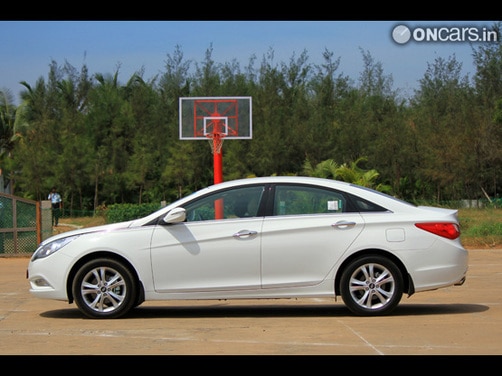
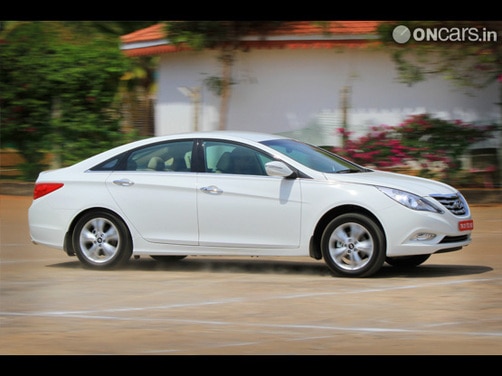
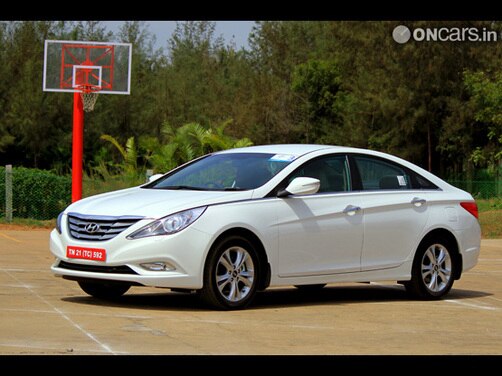
The fluidic design philosophy is inspired by the constant flow of nature – and therefore the new crop of Hyundai cars incorporate design elements that mimic this natural flow. Speaking of which, you get an all-chrome grille upfront which is inspired by the flow and ripples of a cascading waterfall. Two prominent creases extend from this grille and onto the bonnet. The headlights have flowing lines too – on the outer shape as well as the internal elements. A chrome-garnished seam extends out from the headlamps and underscores the windows to significantly highlight the tall belt line. The side profile also gets a prominent crease that flows from the front wheel arch and extends all the way into the taillights. The Sonata’s roof has a coupe-ish flow to it and the narrow glasshouse and receding roofline give an impression that the cabin space could have been compromised.
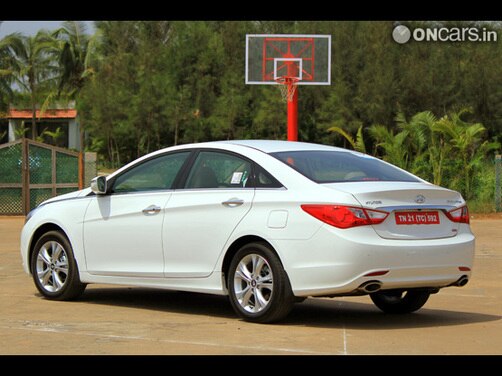
The wrap-around taillights too have a flowing design like the headlights. These units integrate LED taillamps and extend all the way into the boot lid. The rear bumper gets a prominent set of eye-shaped reflectors – much similar to the i10 facelift and the fluidic Verna. There are dual exhaust pipes too and that gives the Sonata a sporty appearance even from the rear.
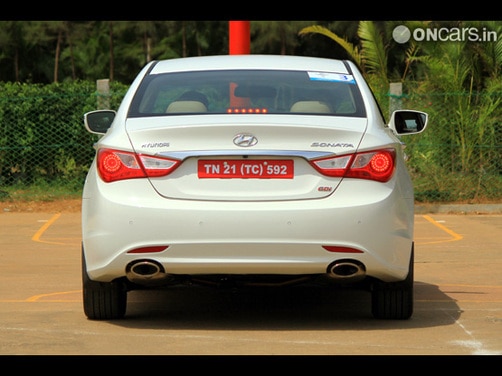
The all-new Sonata then, has a very sporty stance overall with its flowing lines and looks remarkable as compared to its boxy-looking competitors like the Passat, Superb, Accord and Camry. The only car that probably comes anywhere close to the Sonata’s flowing design, is arch-rival Maruti Suzuki’s Kizashi. Look at it from any angle and the Sonata does appear to be a premium sedan and I think it looks best in black.
Also Read:
Hyundai Sonata First Drive User Experience Review
Hyundai Sonata First Drive Performance Review
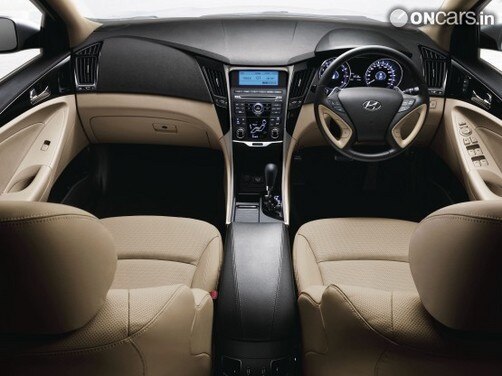
The interiors of the new Sonata also continue to use the flowing lines that you see on the outside. The centre console has the same waterfall effect that you see in the new Verna or even the new Swift/Kizashi for that matter. Like the old Sonata and the rest of its competition, the new Sonata too makes uses of black and beige interiors. However, instead of incorporating any wooden trim in the package, Hyundai has made use of metal inserts to add a hint of sportiness to the flow.
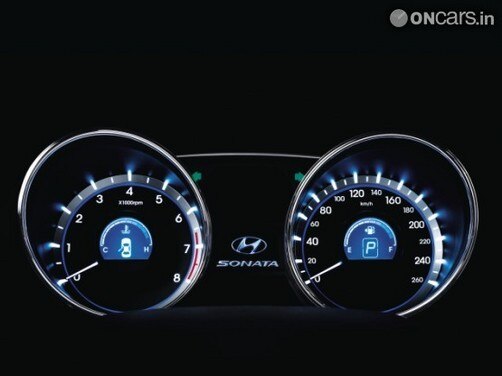
The black and beige scheme finds its way onto the steering wheel as well. The wheel is connected to a rack-mounted electronic power steering unit. You get steering mounted audio / telephonic controls on both the variants of the new Sonata. The instrumentation cluster that sits behind the steering wheel has the now-common-to-all-Hyundai-cars blue backlight – but while that is soothing to the eyes and fits the Verna and i10 well, it seems a tad too bling for a premium sedan like the Sonata. The instrumentation has large read-outs for all the clocks and I particularly like the inclusion of a clear-LCD in the centre to display the vital vehicle information.
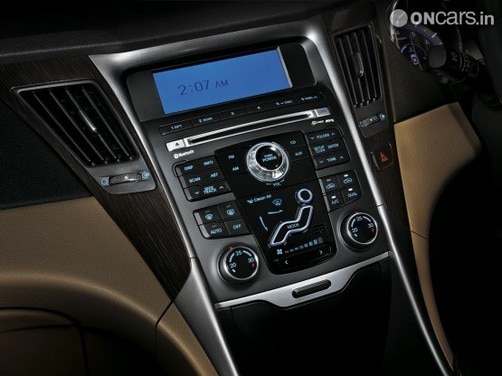
The A/C vents have a vertical design and are mated to a dual-zone climate control. The centre console has an integrated audio system as well and supports varied audio inputs ranging from CD, auxiliary, USB and iPhone/iPod. There is a large button in the centre that is shaped like the driving position of a human. Though it looks novel and takes up a lot of space, it only lets you toggle between the air-flow settings. The Sonata’s cabin is cooled in a jiffy though and adding further value to this cause are the ventilated/heated front seats.
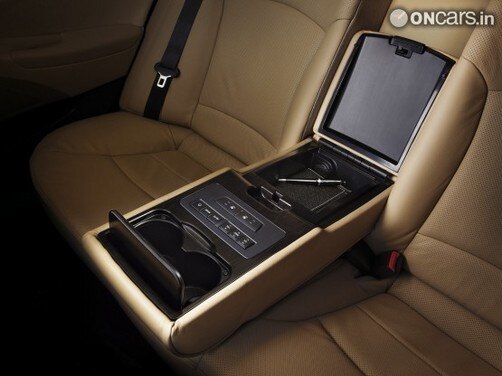
At the back, the rear seats only get ventilation and no heating. The ventilation particularly comes in handy because the rear A/C vents aren’t all that great when it comes to cooling the passengers on the back bench. They do not come with individual fan speed either. I would have preferred a better mechanism here like the B-pillar mounted vents that you find in the Superb / Passat. The rear seats also get a centre arm-rest that has controls for audio and seat ventilation. The seats, front and back, get complete leather upholstery and the cushioning is softer (and I like it that way) as compared to the stiffer seats that you get in the European cars.
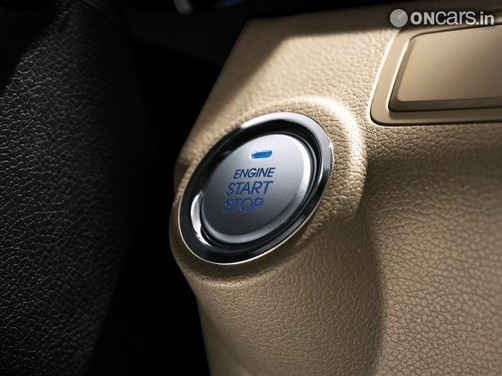
The receding roof-line that we spoke about earlier does not hamper head room in any way. However, the rear seating feels quite low and therefore the ingress and egress could get a tad cumbersome for some. The leg-space too did not feel as plush as a Superb or the Passat, but we’ll wait for a full-fledged comparison before reaching a conclusion on that. The front seats are big and very comfortable too. They come with complete electronic controls for rake, reach and height and the driver’s seat in particular comes with two memory settings as well to help you ‘save’ your settings for seating ergonomics.
Overall, the new Sonata has ample features to keep the customers in the premium sedan segment happy – only when those customers are ready to buy a petrol car though!
Also Read:
Hyundai Sonata First Drive Performance Review
Hyundai Sonata First Drive Design Review
Let us get done with the bad news first. The Hyundai Sonata will be available initially with a petrol engine only. The lack of a diesel engine could make many prospective customers shy away even before taking a test drive of the new Sonata. However, Hyundai affirms that the average running of the vehicles in this segment is close to 60 kilometres per day. That translates to about 2,000 km per month and less than 30,000 kilometres per year. Therefore, the price advantage that diesel fuel offers over petrol in say, three to four years, is far lesser than the extra money you pay for buying a diesel car in the first place. We completely agree with Hyundai on this and in fact, I have personally explained this phenomenon to our viewers and reader while helping them make a buying decision on our Wheelocity show on the Zee Business television channel.
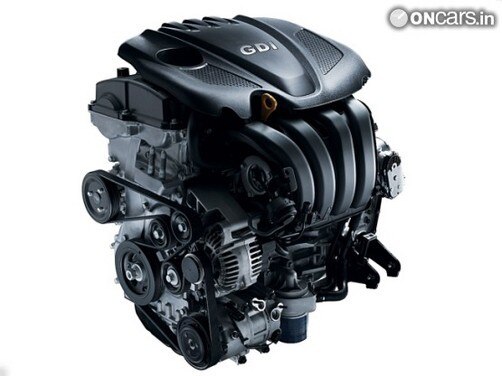
So for now, what you get in the Sonata is a 2.4-litre GDi petrol engine that puts out over 200PS of power and 250 Nm of torque. The beauty of this engine is the direct-injection technology – which places the fuel injectors very close to the cylinders and sprays the fuel directly into the cylinders at almost ten times the pressure of a conventional fuel-injection system. In a nutshell, this technology not only allows for better performance right from the word go, but also ensures better fuel economy.
In India, Hyundai will sell the Sonata 2.4 GDi in two variants – manual (MT) and automatic (AT). While the trim levels for both the models will remain more-or-less similar, under the hood the engine will be mated either to a six-speed manual or a six-speed automatic transmission, in a front engine / front wheel drive configuration. We drove the automatic for most of the distance during our test, with a brief stint in the manual version at a later stage.
Frankly, the automatic gearbox felt confused throughout the drive. Even on part-throttle, in the city, the setup felt too eager to rev and lunge forward – but on the highway, even when I stepped on the throttle, it would think for a second or two before putting the power down. And even then, the Sonata AT doesn’t feel like a 200PS car! The saving grace though, are the paddle-shifters that act like an oasis in the desert if you are a petrol head. The manual on the other had feel much better to drive since you have more control on the engine and the gearbox.
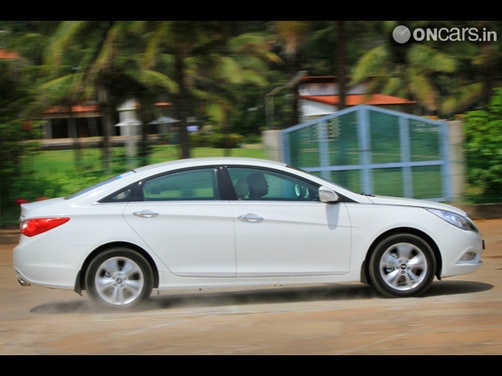
The suspension setup on the Sonata – like most other Hyundai cars – is inclined more towards comfort than sporty handling. Therefore what you get is a soft setup that is ready to gobble most of the undulations that you will encounter on Indian roads. Take it fast around a bend though, and the car feels twitchy and uncomfortable. Add to it the fact that the Sonata is a front-wheel-drive and you understand why that steering wheel suddenly jitters when you power out of the corner. To keep things under check though, you have the regular army of safety features viz. ABS, EBD, ECS etc. doing its job. But all said and done, it’s a luxury sedan and therefore the new Sonata is enjoyed best when driven with the elegance of a chauffeur than the aggression of a racer.
Conclusion
The all-new Sonata is being manufactured locally with some vital components being imported – and in spite of this localisation, the Hyundai Sonata costs between Rs 18 to 21 lakh. At that price point, it will face fierce competition from the Skoda Superb, the Volkswagen Passat, the Honda Accord and the Toyota Camry (no, the Maruti Suzuki Kizashi doesn’t count!).
While the earlier Sonata may not have managed to trouble any of its competitors, the new one has a stunning design as its major trump-card to take on the rivals. If the Fluidic-design philosophy single-handedly managed to turn the Verna’s fortunes, why don’t see a reason why it won’t do so with the all-new Sonata…

For breaking news and live news updates, like us on Facebook or follow us on Twitter and Instagram. Read more on Latest Car and Bike News on India.com.