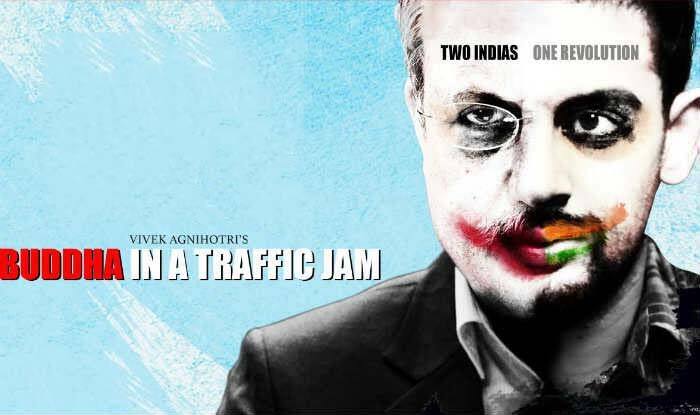
Is there an intellectual tyranny of the Left? Have the flag-bearers of Marxism infiltrated our institutions to produce ‘anti-social’ socialists? Is communism the biggest threat to the sanctity of Bharat Mata and the integrity of this land? Director Vivek Agnihotri’s political drama Buddha In A Traffic Jam attempts to make you believe that uprooting the ‘Left fraternity’ is need of the hour, and perhaps the biggest challenge before the next generation, which wants to uplift the poor rather than glorify poverty.
Buddha in a traffic jam could arguably be the first movie falling under the ‘parallel cinema’ category which does not romanticise with the ‘Left’. Vivek Agnihotri appears to be antidote to the narrative of neo-realism which has been established over the years by the likes of Satyajit Ray, Bimal Roy, Mrinal Sen, Shyam Benegal, etc. And the flawless Anupam Kher looks to champion the cause of the Right, which Balraj Sahni did for the Left.
However, despite a promising premise the movie falls flat. It was a courageous concept, but the implementation is an absolute disaster. The plot absolutely had the potential to explode. But a combination of half-baked dialogues, lackluster acting (except Kher) and visionless direction makes it tough for the viewer to sail through the second half of the feature. (ALSO READ: ‘Buddha in a Traffic Jam’ director Vivek Agnihotri gheraoed by leftist students in Jadavpur University)

Plot
The story revolves around four central characters – marketing student Vikram Pandit (Arunodoy Singh), Professor Ranjan Batka (Kher), his wife Sheetal (Pallavi Joshi) and tribal activist Charu (Mahie Gill). Pandit, as an idealist, begins romanticising with communism, as the only solution to create a just society. But he ends up with a rude awakening, exploring the option of moneyism rather than marxism, which could improve the prospects of the tribal India. However, Vikram’s noble ideas brings him under the radar of naxalites, and their associates who, according to Agnihotri, have infiltrated into every sphere of the society. Of course, the movie has some twists in the tale to sizzle up the anti-climatic conclusion.
Setting
Movie switches between the bourgeois society, where elite students and spoiled brats are availing education in a posh B-school, to the woods of Bastar, where the militant cadres of Maoists are intimidating tribals.


Why should you watch this movie?
The bold experiment of Agnihotri could be definitely given a try. At a time when Indian cinema is overly inclined on stardom, this director banks on a concept which could expose the socio-political ugliness of our system. For beginners in the field of social sciences, there are some iconic moments which could give them a chill. The rivalry between Maoists of Bastar and the state-floated erstwhile counter insurgency force, Salwa Judum is one part where the movie attempted to highlight the nuances. For those enjoying realism with a pinch of salt, the links between naxalites and educational institutions would also be satisfactory to go through. And for those seeking the single-most convincing reason to watch this movie, Anupam Kher’s work on the screen deserves some cash to be flowed out of your pocket. It was another masterpiece of a performance by the veteran actor.

Why you should give it a skip?
Direction lacks vision. The filmmaker, despite having the valour to enter into this subject, could not give it a logical colour. The viewer in the end remains confused. Several factors in the plot could not be substantiated. Stereotypes have been displayed, rather than nuances, which again raises doubt whether the director had complete knowledge of the subject. The dialogues are not strong enough. The acting is unpolished on part of newcomers. Cinematography is also not upto the mark. Most importantly, the movie will neither leave you with more questions nor answer the ones it raised throughout the plot. After creating such a grand hype through his theatrics in JNU and Jadavpur University, director Vivek Agnihotri ended up disappointing the viewer, who came to the theatre predicting something special.
Background scores and music
The rustic background scores pumps up the viewer and adds much more thrill to the plot. These tones come into play during the scenes where the tribals are being oppressed by both – Naxalites and Salwa Judum. On the otherside, Western music is used to add colours to the scenes where the elitism of the left-inclined students is highlighted. The latter ones are mediocre to say the least.
Rating: 1.5/5*






For breaking news and live news updates, like us on Facebook or follow us on Twitter and Instagram. Read more on Latest Entertainment News on India.com.