





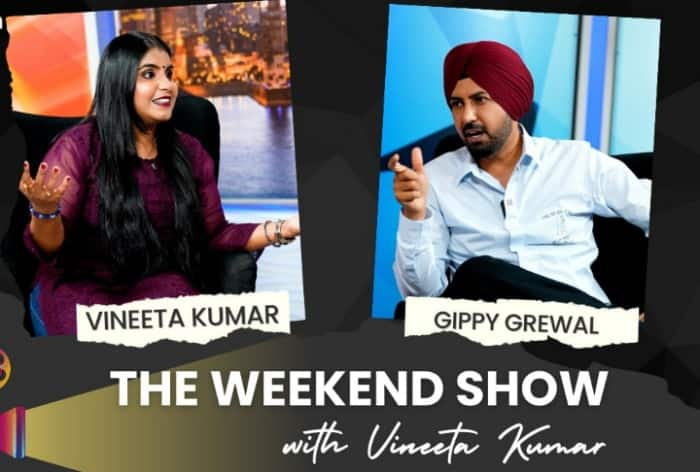
He’s wearing a blue checkered Dior shirt and black Gucci shoes, but the maroon turban brings the entire look together. Even with all his fancy accessories and style, his simplicity shines the brightest. There’s something about Punjabi artists which makes you like them a bit more. Gippy Grewal, one of the most influential and popular names in the Punjabi film and music industry, folds his hands and thanks us for welcoming him into the studio. He is not the one to be doing a small talk but once you get into a conversation with him, Gippy will transport you to his world where only honesty seems to prevail. He is here to talk about his film ‘Shinda Shinda No Papa’. As he begins to explain the theme of the film and how it captures the beauty of Indian parenting, Gippy pauses for a moment. He is getting into the ‘proud-daddy’ mode. The actor speaks about working with his son in the film.
Gippy and his son Shinda feature in the Punjabi film Shinda Shinda No Papa and he reveals that his son wants to be a basketball player. “Uski ye fourth film hai. Luckily uska graph bahot acha hai. Vo mujhe mazak me bolta hai ki ‘papa mera 100 per cent score hai’. Vo bolta hai maine abhi actor banna nahi hai. Maine player banna hai. He is into basketball. Kehta hai ‘maine game khelni hai’. Sab kuch vo game ke liye hi karta hai. Mujhe acha lagta hai that he is trying to do so much and everything at this young age,” he explains with joy and pride in his eyes.
Gippy is patient with every question. He talks about the rise of the Punjabi film industry and how Carry on Jatta 3, a film starring him alongside Sonam Bajwa and others, is the biggest Box Office success in the industry. He says the journey is long and he is taking baby steps to establish the Punjabi film industry as the industry which is producing universal stories. Gippy, however, highlights how universal themes require big financial investment which is what the Punjabi film industry lacks in a certain aspect.
The actor continues to share his knowledge about filmmaking and anecdotes from his childhood. He remembers his late father and reveals how he was the only person who would support him in following his dreams. Gippy says, “I did odd jobs in Canada. I never imagined myself living the life I am living today. No day goes by when I don’t remember my father. But, it was probably the will of God that he could never see my success. I regret that but I know he’s looking after me from up and beyond and perhaps everything I have is because of his blessings from the above.”
His team stands behind the cameras, looking engrossed in the interaction. Nobody is looking at the watch and one can only take it as a sign of having a good conversation. I ask him about Amar Singh Chamkila, the new Netflix film by Imtiaz Ali in which Diljit Dosanjh, Gippy’s frequent collaborator, plays the titular role. The actor appreciates the efforts but also mentions how the story needed a Punjabi actor or else it would have been difficult to relate to the film. “Unhone Diljit ko liya. They took the right artist. Had they cast anyone else, I probably wouldn’t have been able to relate. At least the Punjabi viewers wouldn’t connect with the film. Chamkila belongs to the Punjabi audience first and then to the rest of the world. It has to appeal to me first and then only it can appeal to other viewers. If you take the right kind of artist, it helps. He has done a wonderful job and Imtiaz sir has also done a good job with the film,” he says.
But, is it easy to be a Punjabi artist in a world where so many artists in the past have been attacked and murdered? Doesn’t Gippy feel vulnerable? The actor says he can’t stop what is happening in the world. I remind him of the threats that he received from a gangster in December last year. He says like Chamkila, he believes in doing his job. “Jo cheezen ho rahi hain aap unhe taal nahin sakte, but you can be cautious. Hum isi cheez ke liye paida huye hain, hum yahi karengi, hum kahin aur bhi chale jate thai to phir wapas aa jate hain. Jahan aapka dil hai, wahi kaam karna chahiye,” he explains while referring to the scene in which Chamkila continues to work despite the death threats.
Gippy continues with his ‘haanji’ and ‘hai na’ as if trying to ensure that the conversation is going in the right direction. He takes his time in understanding and comprehending the mood of the questions. The actor talks about the uncertainties of his profession. He also says his work stops him from looking a certain way or appearing carefree. “I want to relax. I want to be able to roam around in my kaccha, not take a shower and eat at any place but I can’t do that. I can’t do it because I can’t be photographed like that. I cannot say no to my fans because it is because of them I am what I am today,” he adds.
You expect every interview to turn into a conversation but you don’t get to see that happening often. It’s not because your questions aren’t right but most of the time, the answers are either not honest or rushed into. It takes an artist like Gippy to open up with all his vulnerabilities and histories for a basic interview to become a joyous exchange of ideas and emotions. And as far as my experience goes, no one else speaks with as much heart as Punjabis do. One interview at a time!








For breaking news and live news updates, like us on Facebook or follow us on Twitter and Instagram. Read more on Latest Entertainment News on India.com.
