


Intraventricular brain tumors are tumors that are found deep inside the brain. They are found in the spaces called ventricles where fluid of brain flows. This type of surgery is very challenging in the field of neurosurgery. As the tumors are very deep, Surgeons need to pass through important areas of brain so that tumor can be reached. These are the areas which control important functioning of our body. These control movement, thinking and speech too. So, surgery was also risky. Earlier methods often meant that the tumor removed, but some brain damage risk remains. Doctors always had to balance two things. First was to reach the tumor and second to protect the brain.
Recently Neurological Society of India 2025 conference was held where various doctors gathered. At NSI, indian doctors shared new clinical data. This data suggests safer surgical techniques may now be possible. This means that better access and less brain injury risk is possible.
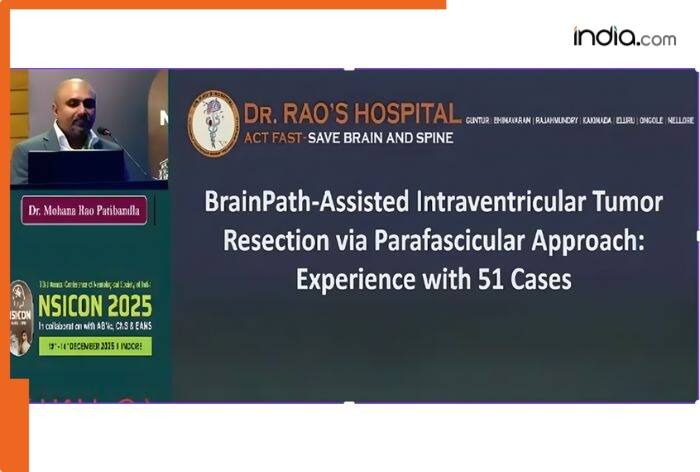
At the conference, Dr. Mohana Rao Patibandla who is a senior neurosurgeon shared his work. He presented 51 patient cases done one after another. These surgeries used BrainPath-assisted parafascicular technique. It is a modern, minimally damaging route to deep brain tumors. The tumors were inside the brain ventricles. These are very sensitive areas of brain. This is the first long-term and regular use of this technique in India. It is also the largest Indian case series reported so far using BrainPath. But People noticed the presentation because of large number of cases. It was also important as same method was used consistently. There was a clear focus on patient results. There was no focus on hype or marketing.
Why intraventricular tumors are different
Tumors in the lateral, third, or fourth ventricles are rare. But they are very complicated to treat when they happen. Because they grow deep inside the brain. Symptoms for this tumor appear late. Common symptoms include hydrocephalus which means fluid buildup in the brain. Another symptom is high brain pressure which causes headache and vomiting. Other symptoms include memory or thinking problems and vision issues. These surgeries are very difficult because doctors need to reach deep tumors. The surrounding brain areas control movement, thinking, memory and behaviour & personality. One wrong move can cause serious or a permanent damage to patient. These tumors are rare but dangerous. This is mainly because of where they sit. This deep location led to late symptoms and high surgical risk.
Doctors have used traditional surgical routes for many years. There are two common methods. First one is Transcortical. In this method, cutting is through brain tissue. Another method is Transcallosal. In Transcallosal, surgery is done passing through the brain’s connecting fibres. These methods do reach the tumor. They work but there is a big problem in these methods. They pass through healthy brain tissue to get there. This can cause new neurological problems after surgery. Some may experience issues in moment, memory, thinking and even in speech. The risk is especially worrying for children and young adults. The damage can affect their whole future. Tumor could be out but sometimes brain had to pay price.
The parafascicular shift
Brain surgery techniques have improved worldwide in the last 10 years. Surgeons now prefer parafascicular approaches. This means moving between natural brain fibre pathways. Instead of cutting through healthy brain tissue, now it only moves. This method reduces unnecessary brain damage. Tools like BrainPath help by creating an entry path. The entry path is very thin and like a tube. There are advanced navigation systems. These system guide surgeons accurately to the tumor. The results are very impressive. Deep tumors reached safely and precisely. In India, this method was earlier used only in a few isolated cases. There was no organised data which is large enough to judge its real success. The NSI 2025 presentation filled this gap. It showed proper results and outcomes from one centre. And it was not coming from scattered cases.
What the 51-case Indian series showed
The data was including both children and adults. Tumors were found in the lateral, third, and fourth ventricles. Same minimally invasive parafascicular method was used for each and every person. There was no use of random techniques. Surgeons were able to remove most or it can be said that almost all of the tumor in most cases. Very few new neurological problems were caused by the surgical approach. Blood loss during surgery stayed low. In some of cases tumors were very deep. Still, Operation time was reasonable. They were not focusing on showing off something “new.” The focus was completely on safety and practicality. Doctors were honest about limitations. One of the limitations was that the bumber of patients was still small. Also, long-term effects on thinking and memory need further follow-up.
Why this matters for Indian healthcare
The series was important for the surgery. But it was also very important for Indian neurosurgery as a whole. Earlier it was thought that the advanced minimally invasive techniques can only work in a few top global centers. The NSI 2025 data shows that India can successfully use these techniques too. If the right skills and infrastructure are provided, India can also use it. Conference attendees highlighted that local data matters for training new surgeons. It is also needed for guiding patient discussions and for creating future guidelines. Modern neurosurgery now not only focuses on removing tumors. But it also focuses on saving brain function. Evidence generated in India itself is very valuable. It is as valuable as learning techniques from abroad.
A measured academic tone
The NSI 2025 session didn’t brag about the technology. There was focus or trying to “sell” the method. The discussion emphasized on choosing the right patients. They discussed about careful planning regarding anatomy and learning curve for surgeons. Also, the discussion focused on ethical responsibilities with new technologies. This made the work feel like a starting point. This work can be further used as reference. It didn’t feel like the final word. It reflects a broader medical trend. Innovation should always be guided by data and honesty. There should be proper focus on long term responsibility.
Broader implications
India is growing advanced medical care. Now such surgeries can be done outside big cities. Safe and consistent neurosurgery will impact patient results across the country. Parafascicular intraventricular surgery are very effective. But a fact is that they won’t immediately replace traditional methods. But it gives surgeons another valuable option. When saving brain function is crucial, then it is very effective. The method is best for carefully chosen patients. It can’t work in every case.
About the presenter
Dr. Mohana Rao Patibandla is a senior neurosurgeon from India. He is the Founder, Chairman, and MD of Dr. Rao’s Hospital in Guntur, Andhra Pradesh. The hospital focuses on neurology, neurosurgery, and spine care. He has 20+ years of experience in the field. He is trained in minimally invasive neurosurgery. He has also done training in areas like pediatric neurosurgery, skull base surgery, epilepsy surgery, neuro-oncology, and functional neurosurgery. He has completed his train in both India and the United States.
Looking ahead
The 51-case series from NSI 2025 is not the final conclusion. It can act as an early benchmark for India.
It encourages collaboration between hospitals. There should be long-term follow-up studies. Structured training for surgeons should be arranged. The series shows a subtle but important change in Indian neurosurgery. The change will focus on precision, Caution and restraint. It will be respecting brain anatomy, even in very tough surgeries. In short, it’s a starting point which signalises a smarter and safer brain surgery in India.

For breaking news and live news updates, like us on Facebook or follow us on Twitter and Instagram. Read more on Latest Money News on India.com.