


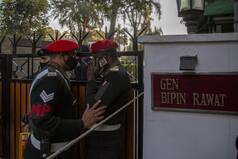


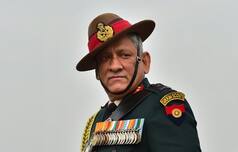
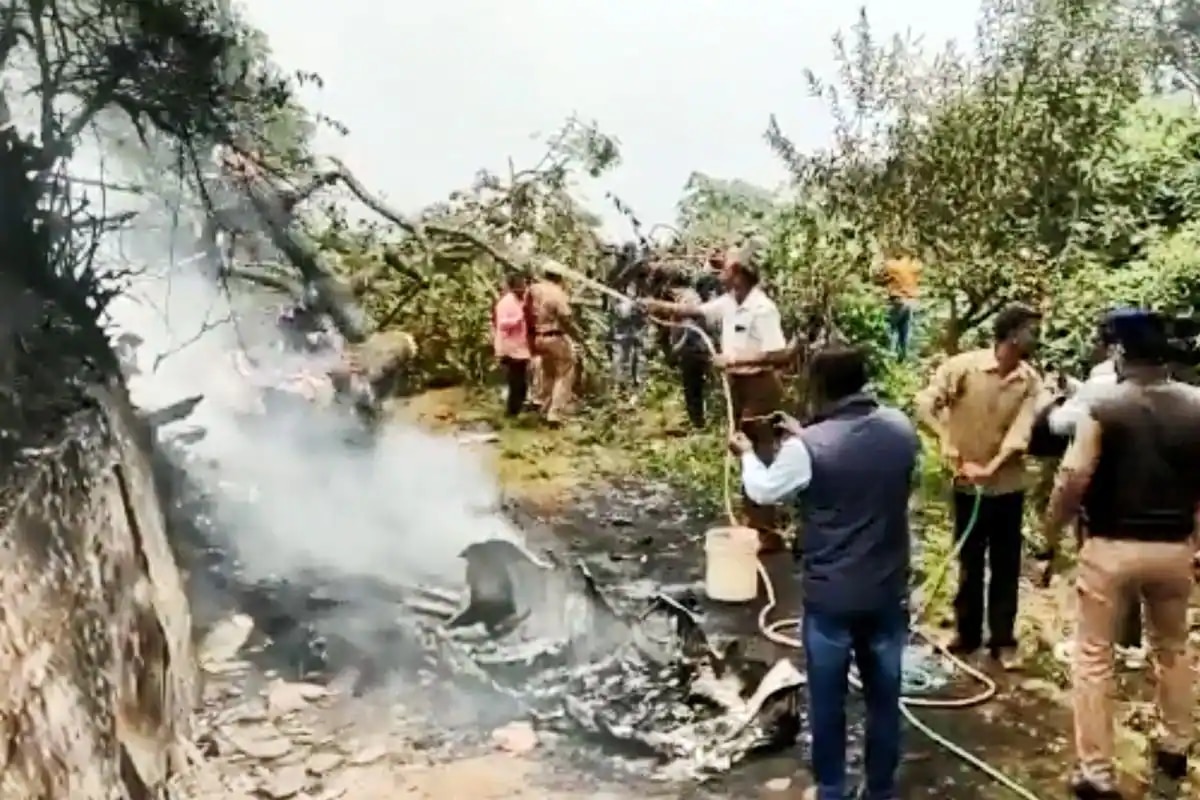
New Delhi: Indian Air Force (IAF) Chief Air Marshal VR Chaudhari on Wednesday submitted a detailed report to Defence Minister Rajnath Singh on the findings of the probe of the IAF helicopter crash near Coonoor that killed CDS General Bipin Rawat and 13 other Armed Forces personnel. Air Marshal Manvendra Singh was present during the meeting that apprised Rajnath Singh on the findings of the probe. Defence Secretary Ajay Kumar and a number of senior officials of the ministry were also present when the IAF officials briefed the defence minister. The tri-services probe report also included recommendations for future chopper operations for flying VIP personnel.
No technical snag or sabotage and bad weather leading to a phenomenon called Controlled Flight Into Terrain (CFIT) is believed to have been identified as the prime reason for the chopper crash, people familiar with the development were quoted as saying by news agency PTI.
The people cited above said the investigators have ruled out any possibility of technical snag or sabotage in the crash of the Russian-origin twin-engine Mi-17V5 helicopter that was flying from Sulur airbase to Wellington on December 8.
There is no official comment on the probe report either by the Indian Air Force or by the defence ministry.
According to experts, the CFIT refers to a phenomenon when an aircraft under control is piloted into the ground, water or other terrains largely due to bad weather or pilot error. The CFIT generally takes place in bad weather conditions or when a flight is landing.
According to the IATA (International Air Transport Association), CFIT refers to accidents in which there was a collision with terrain, water, or obstacle, without indication of loss of control of the aircraft. “The critical distinction in these types of accidents is the fact that the aircraft is under the control of the flight crew,” it said.
The Federal Aviation Administration of the US government described CFIT as an unintentional collision with terrain (the ground, a mountain, a body of water, or an obstacle) while an aircraft is under positive control. “Most often, the pilot or crew is unaware of the looming disaster until it is too late,” it said.
The people cited above said a sudden cloud cover could have resulted in the CFIT. “At times, a pilot may lose situational awareness when there is a visual disruption,” said an aviation expert.
Visuals of the helicopter captured by locals before the crash had shown that the chopper was flying at a low altitude. The chopper had crashed around eight minutes before its scheduled landing at Wellington.
The people said the probe team examined all likely scenarios for the crash including possible human error or whether it was a case of disorientation by the crew when the helicopter was preparing for landing.
Gen Rawat’s wife Madhulika, his defence advisor Brigadier LS Lidder, staff officer to the Chief of Defence Staff, Lt Col Harjinder Singh and decorated pilot Group Captain Varun Singh were among 13 others killed in the crash near Coonoor in Tamil Nadu.
Air Marshal Singh, who headed the probe team, is currently serving as Air Officer Commanding-in-Chief of the Bengaluru-headquartered Training Command of the IAF. He is known to be one of the best air crash investigators in the country.
Before taking the reins of the Training Command, the Air Marshal was the Director General (Inspection and Safety) at the Air headquarters and developed various protocols for flight safety while serving in the post.
(With inputs from PTI)




For breaking news and live news updates, like us on Facebook or follow us on Twitter and Instagram. Read more on Latest India News on India.com.
