





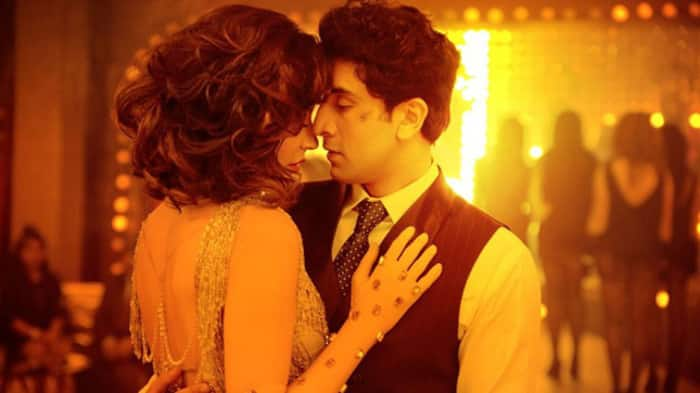
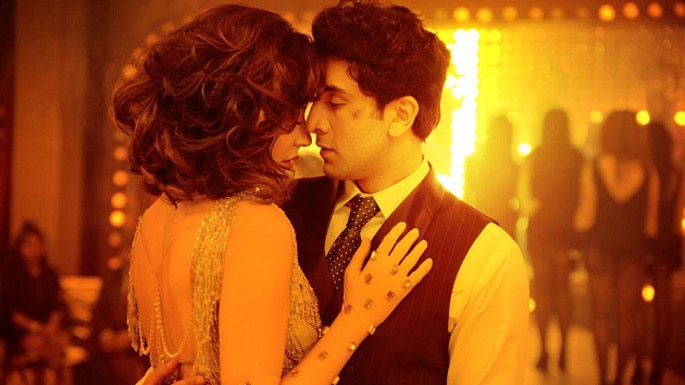
There’s no doubt about it: “Bombay Velvet” is visually stunning. How could it not be? Set in Prohibition-Era Bombay, with an amber-tinted lens lending a retro haze to sets of sprawling cabaret bars and cramped brothels; candlesticks illuminating darkened room corners; twinkling marquees rising up between urban alleyways, director Anurag Kashyap has both recreated—as well as reimagined—a city that is nothing short of dazzling in both its grit and glory.
In fact, many have faulted Kashyap for his liberal use of cinematic license on Mumbai’s past. I wouldn’t be so foolish as to fancy myself an expert on the history of the city, so I’ll leave the fact-checking to the experts. Besides, it’s not so much his lapses in accuracy that are bothersome as the flimsiness of the story, cracking under the weight of all that stylistic excess.
Johnny Balraj (Ranbir Kapoor)—a character unabashedly inspired by the likes of both Cagney’s Eddie Bartlett and De Niro’s Jake La Motta—is a street rat whose sole dream after a childhood spent in poverty is to make it big in the “soon to be metropolis” (as one news headline puts it) that is Bombay. He sees his chance when he encounters Kaizaad Khambatta (Karan Johar), a journalist whose mobster connections keep him well supplied with both a colorful wardrobe and a steady stream of whiskey. Khambatta makes Johnny his henchman as well as the owner of his new nightclub, Bombay Velvet. But when Khambatta’s rival sends his mistress, Rosie Noronha (Anushka Sharma), to sing at the club and charm Johnny into spilling dirt on his boss, the two fall in love, setting the stage for a whole lot of bumps in the road for both their romance as well as Johnny’s get-rich-quick plan.
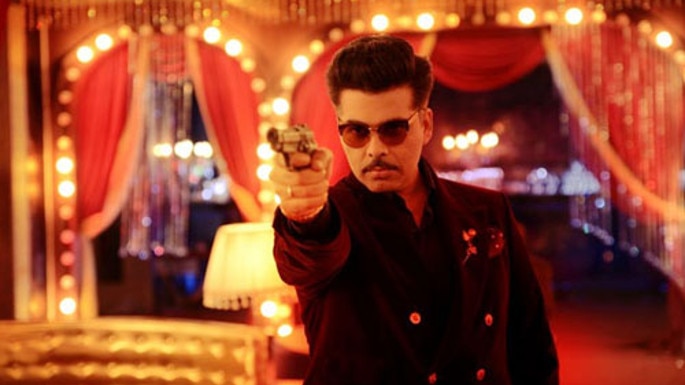
In Kashyap’s most expensive film to date in terms of the time and money needed to make it (almost a decade in the making and reportedly an over-80 crore budget), the “Bombay Velvet” team has paid impressive attention to detail in order to evoke a classic city on the brink of explosive urbanization: vintage typewriters and old-timey advertisements for Duke’s soda are plastered on city walls as evidence of Errol Kelly and Sonal Sawant’s astute production design, while makeup artist Puneet Saini and costume designer Niharika Khan transform Sharma into a heavy-lidded (and unnaturally plump-lipped) vision swathed in floor-length magentas and head-to-toe beaded white lace. Amit Trivedi’s score is a jazz age-inspired blend of plinky-planky piano and swinging brass. As swanky as the backdrop is, it is both a blessing and a curse; a sensory treat on one hand, and on the other, throwing into sharp focus the inability of the story and screenplay to live up to the lavish packaging.
Well aware of his appeal to a specific niche of the national audience, Kashyap has gone on record to declare that to lure a wider audience into the theaters in India, one needs a good love story. It’s disappointing, then, that the initial stages of the love story meant to anchor this film are established over the course of a hasty, music-backed montage sequence, giving us little real insight into the how’s and why’s of Johnny and Rosie’s connection. Moreover, the romance gets sidetracked much too often throughout the course of the film, the shaky narrative focus leading to a pace that lags wearily from one betrayal to the next, even the twists lacking the necessary thrills to justify them.
Individually, the actors do their darnedest to bring their characters to life. Despite his rather contrived curls, Kapoor’s angst-ridden portrayal is earnest, and while Johnny isn’t particularly endearing, Kapoor infuses a subtle humor and innocence into his otherwise mercurial disposition. Surprisingly, the against-the-grain casting of Johar as a villain doesn’t entirely misfire, and in addition to obviously relishing lines like “you look like hired help,” he treats us to some unexpected shining moments as Khambata; most notably, a scene in which he breaks into uncontrollable giggles, revealing that there’s a layer to the character beyond his scheming, smirking façade. Even Sharma reveals hints of palpable pain under her otherwise one-note expressions, although her playback singers Shalmali Kholgade, Suman Sridhar and Niti Mohan do most of the emoting for her with remarkable fervor in their vocal performances. But together, the cast’s chemistry fizzles. Whether it’s Johnny’s brewing resentment towards Khambatta or his rocky romance with Rosie, there is a flatness to the relationships that fatally diminishes the impact of an already haphazard story.
“Bombay Velvet’s” long-windedness, despite its best intentions, ultimately fails to sustain our attention. Determined to be an epic, plagued love story played out against the buzzing energy of a chapter in history that seems perfect for the big screen, the film seems much less interested in capturing the era narratively than stylistically. All fedoras, flowy gowns and feathered headdresses, it certainly makes for a pretty piece of work, but there isn’t enough substance underneath to make it a masterpiece.







For breaking news and live news updates, like us on Facebook or follow us on Twitter and Instagram. Read more on Latest India News on India.com.
