





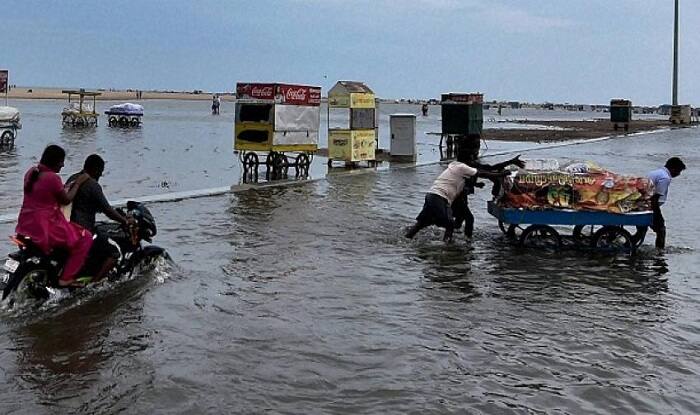
Chennai, December 25: History has yet again shown what happens to societies that fail to learn from it. Exactly one year after the highly devastating floods in Southern India’s cosmopolitan city of Chennai, nature’s wrath has once again hit the state of Tamil Nadu. The cyclonic storm ‘Vardah’ lashed out in full force at the city and resulted in extensive damage to both life and property. With winds blowing at speeds up to 140 kph, the central government had to evacuate more than 20,000 people living on the shores of Tamil Nadu and Andhra Pradesh to relief camps.
Despite, the last-minute measures, at least ten people died in the wake of Cyclone Vardah and more than 250 trees were uprooted across the city. Further, the loss of trade and property were so extensive that the Indian chamber of commerce and industry, Assocham, said that Cyclone Vardah caused an economic loss of Rs 6,749 crore ( $1 billion).
What is more upsetting than the aftermath of the cyclone, however, is the fact that for Chennai, the events bring to mind a sense of déjà vu. In December 2015, the city received the heaviest rains in 100 years, that caused floods lasting for weeks. With losses worth up to a whopping $2.2 billion and insured sums amounting to $755 million, the Chennai floods were historic indeed. However, as Cyclone Vardah shows the environmental lessons remain yet to be learnt.
While climate change definitely had a role to play, the destruction and loss can largely be attributed to human-induced factors such as pollution and infrastructural failure. With a population of over 8.2 million people, the city’s ailing infrastructure comprises of over 150,000 illegal buildings. Further, due to a constraint of space, the buildings have been constructed on, what used to be, thriving water bodies such as rivers, ponds and streams.
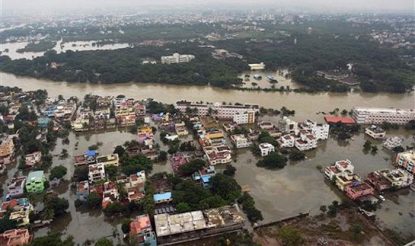
(Aerial view of construction on riverbeds)
According to a report of the Parliamentary Standing Committee on Home Affairs, the civic and humanitarian crises were perpetuated by the fact that the state had carried out inadequate flood zone planning and desilting was not done in a timely manner. The report acknowledged the following three reasons as being the main cause of the disaster:
A similar cause for the extensive flooding was highlighted in a report by the Centre for Science and Environment (CSE), New Delhi, that stated, “Chennai has only 855 km of storm water drains against 2,847 km of urban roads. Thus, even marginally heavy rainfall causes havoc in the city.”
In the wake of the 2015 torrential rains, the central government had demanded that the following action be taken immediately to protect the environment and the people living the region, while at the same time ensuring that a repeat of the horrific disaster does not occur:
One year on, the destruction following the Cyclone Vardah shows that authorities have done little to minimise the human-induced flaws that wreak havoc in the wake of disasters. Rather than revisiting the construction and layout of key structures in the city, further invites are being sent out to usher in infrastructure development under “Make in Chennai”.
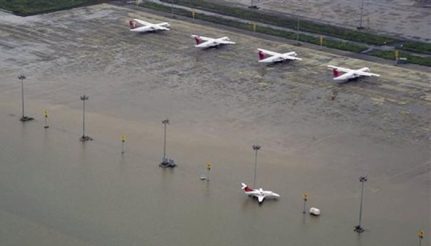
(Chennai airport built on the banks of river Adyar)
Some of the key structures that Chennai continues to harbour on expressly forbidden floodplains include the city’s airport, that has been built on the banks of the River Adyar and an intricate metro rail system built solely over the Buckingham Canal and the Pallikaranai marshlands. Many other IT hubs, landmark buildings, highways and roads, follow the same pattern of construction.
Apart from the fact that Chennai remains highly prone to extensive water logging, the cyclonic storm also shows that Tamil Nadu, like many other India states, remains highly unprepared to deal with the carnage caused by sheer wind. As the events following the cyclone show us, unless immediate action to rectify the existing wrongs and restore the environment to its original state is taken, nature will insist on teaching us a lesson repeatedly.








For breaking news and live news updates, like us on Facebook or follow us on Twitter and Instagram. Read more on Latest India News on India.com.
