





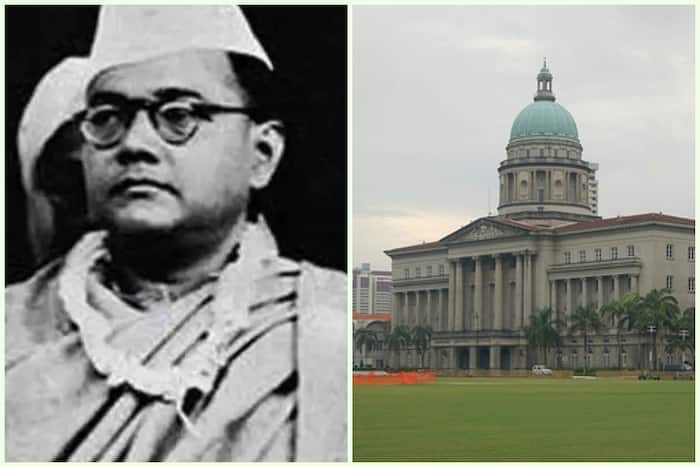
Delhi: Netaji Subhash Chandra Bose was amongst the most eminent freedom fighters India had ever seen. He was also one of the most influential leaders who had a pivotal role in getting India’s Independence from the British Raj. He had raised the slogan ‘Çhalo Dilli’ which got immortalised in time, when he was in Singapore. On Tuesday, Singapore declared its iconic green site Padang, from where Netaji Subhas Chandra Bose gave the slogan in July 1943, as its 75th national monument as the city-state celebrates its 57th National Day.
In view of its strong national, historical, and social significance, the Padang is now preserved and accorded the highest level of protection in Singapore under the Preservation of Monuments Act, said the National Heritage Board (NHB).
The Padang, meaning a field in Malay, was distinguished by its public nature, as one of the only few open spaces accessible to the public in the colonial period. According to PTI, Professor Rajesh Rai, Head, South Asian Studies at the National University of Singapore, recapped the Padang’s link to the Indian National Army (INA).
The Padang has special significance for the Indian community in Singapore. It was here that Indian sepoys first established their camp sites when the British established their outpost on the island.
This was also the place where Netaji delivered several speeches to the tens of thousands of Indian National Army (INA) soldiers and the local Indian population. It was here that he gave the Chalo Dilli slogan, set up the Rani of Jhansi regiment, and called for the total mobilisation of Indian resources to free India from British rule. Just before the war ended Bose established the INA memorial at the southern edge of the Padang, the professor said.
Today, a historical marker for the INA remains at the site.
The 200-year-old Padang joins 74 other National Monuments in Singapore, seven of which are related to the Indian community in the multinational city-state.
In a bid to counter the imperial rule, Bose had formed the Azad Hind Fauj. This military regiment was assembled to fight the British army. It also had an all female battalion that was called the Rani Jhansi Regiment. It was named after the fearless Queen of Jhansi who fought during the first war of Independence, dauntlessly guarding her fort. This regiment welcomed women who wanted to become a part of the freedom struggle.
The large field of Padang, popular for sporting events such as cricket, football, hockey, tennis, and lawn bowling, is one of the oldest open spaces continuously used since the 1800s. The Padang was gazetted on Tuesday as Singapore celebrated its 57th National Day amid a parade by uniform groups and a colourful display of local culture and dances by schools and civic groups.
The victory parade of the Japanese surrender on September 12, 1945 was held on the Padang, which has since been witnessing Singapore’s history, including the victory rally of the first fully elected Legislative Assembly on June 3, 1959.
(With PTI inputs)








For breaking news and live news updates, like us on Facebook or follow us on Twitter and Instagram. Read more on Latest India News on India.com.
