

New Delhi, April 27: With the resumption of Foreign Secretary-level talks, the ice between India and Pakistan broke to a certain extent. But the frost remains in place. If one takes cue from the kind of strategy adopted by New Delhi to deal with its irritant neighbour for the past decades, it could easily be sensed that the relation between the two countries would comparatively improve in a romantic manner, with Prime Ministers of both the nations sharing a bonhomie. (ALSO READ: Diplomacy Narendra Modi style: Stitching a new era from where Atal Bihari Vajpayee left off)
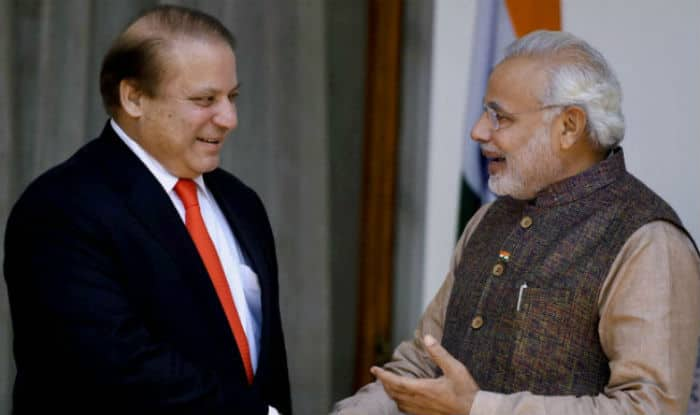
From the days when Vajpayee delivered the historic speech at Minar-e-Pakistan of Lahore, to the era when Asif Ali Zardari decorated Manmohan Singh’s ancestral village in Pakistani Punjab, to the breaking of protocol by Narendra Modi to join his counterpart Nawaz Sharif’s birthday bash, peace-lovers across the border had ample opportunities to turn optimist. But there was no results in the end to cherish about. The deceitful tactics of Pakistan remains in place, with the country still giving shelter to non-state actors and dreaded criminals who are relentlessly working on their anti-India agenda.
Here are the 7 faultlines in New Delhi’s foreign strategy which prevents it from diplomatically overpowering Pakistan:
1. Depending on the West as a mediator
Successive Indian governments have wasted their efforts by trying to convince the West that Pakistan’s military establishment is behind some of the major terror attacks which were perpetrated on the Indian soil. Does the nation with the third largest military might in the world require global sympathy for its plight?
2. Keeping faith in Pakistan to act on its home-grown jihadi elements
Pakistan’s former dictator General Zia-ul-Haq, had summed up in one word about how the nation views India. Gen Zia used the derogatory term Kafir (non-believers) to refer to India. Most of Pakistan’s popular leaders have played the anti-India card to project them as true ‘nationalists’. None of them have mustered up the courage to criticise elements like Maulana Hafiz Saeed, Masood Azhar and Zakiur Rahman Lakhvi.
However, India keeps providing evidence after evidence to the neighbouring nation, hoping that the civil establishment would pay heed to the terror activities which are planned, conceptualised and co-ordinated from its soil. The ultra-nationalist government of Narendra Modi even went ahead by allowing Pakistan’s probe committee to arrive in India and inspect the Pathankot airbase where Jaish-e-militants launched a fidayeen attack.
3. Maintaining economic ties with Pakistan at all-cost
When it comes to relation with the neighbouring nations, India has always upheld the Gandhi’s policy of Ahimsa. Capitalising on the opponent’s weakness was something which was forbidden by the Mahatma. This principle is reflected in the fact that even after the 26/11 terror attack in which more than 150 people lost their lives, India did not snap economic relations with Pakistan.
With the El Nino impact hitting the neighbouring nation as well, their agricultural production has remained below 2 per cent. This requires Pakistan to import food products from all SAARC nations, especially India. One of most primary diet of the nation is meat. Interestingly, India is one of the largest exporters of livestock, including buffaloes for Pakistan. In 2005, Islamabad procured additional bulls and buffalloes from India to bring down the prices of beef which was creating major upheaval among their middle class.
4. Trusting Pakistan’s political class
What was the result of the ‘historic’ Agra Summit of 1999? Atal Bihari Vajpayee was backstabbed as the Pervez Musharraf ordered his army to invade Kargil. Time and again, Indian leaders have hosted Pakistani politicians in private as well to discuss contentious matters. From Zulfikar Ali Bhutto to Asif Ali Zardari, all have agreed to solve the Kashmir imbroglio in the most amicable manner. However, their colours change as soon as they return within their territory where the key to score electoral points is to paint India as an antagonist.
Before the Simla pact of 1972, then Pakistani President Zulfikar Ali Bhutto met Indira Gandhi in a private meeting. As per the revelations made foreign secretary JN Dixit, Bhutto had agreed to solve the menace surrounding the Line of Control between India and Pakistan. However, he urged Indira to exclude the point from the Shimla agreement, as it may deteriorate the domestic political situation.
5. Lack of decisive action
Pakistani hypocrisy has been exposed with the kind of shelter the country’s military, ‘and civil’ establishment offers to the likes of Hafiz Saeed, Masood Azhar, Zakiur Rehman Lakhvi and Dawood Ibrahim. The presence of non-state actors like Lashkar-e-Toiba, Lashkar-e-Jhangvi, Jaish-e-Muhammad have been proved beyond a doubt. When Narendra Modi promised during his prime ministerial campaign that he would teach Pakistan a lesson in the type of language it understands, the saffron icon struck a chord with nation’s every aam aadmi whose heart beats for those who lost their loved ones in terror attacks. Nation gave him a mandate to tackle Pakistan in a decisive manner rather than turning up at Lahore to wish Nawaz Sharif on his birthday.











For breaking news and live news updates, like us on Facebook or follow us on Twitter and Instagram. Read more on Latest India News on India.com.