



Nivedita Dash
Nivedita Dash is an Assistant News Editor at India.com, where she leads a dynamic editorial team and oversees the platform’s daily news operations. With over 15 years of experience in Digital and Pr ... Read More



South Korea thought it was close to finalising its long-awaited crypto framework. Instead, the entire effort has stalled over one question regulators cannot agree on: who can issue stablecoins in South Korea?
The delay has now pushed the Digital Asset Basic Act into 2026, after regulators failed to meet a late-2025 deadline to finalise stablecoin rules.
The latest South Korean crypto law update reveals that the delay in implementing the Act is being driven by a disagreement between regulators over won-pegged stablecoin issuance rules.
The central bank wants stablecoin issuance tightly controlled by banks, while financial regulators argue that restricting issuance would shut out fintech firms and slow innovation.
Until that question is settled, South Korea stablecoin regulation remains on hold.
Financial authorities expect only 2–3 bank-centered consortia to qualify as initial stablecoin issuers once regulation is finalized.
Why South Korea’s stablecoin regulation delay creates real problems
The lack of clarity around who can issue stablecoins in South Korea is creating practical problems for markets, regulators, and companies trying to plan ahead.
BoK Governor Rhee Chang-yong even cautioned, “If we allow non-banks to issue stablecoins, this will cause major chaos,” underlining the central bank’s resistance to broader issuer eligibility
Another unresolved issue is reserve supervision, with proposals mandating 100% backing in low-risk assets and custody by licensed institutions, but no agreed enforcement model.
It’s wise to remember; prolonged regulatory uncertainty rarely keeps activity on hold. It usually pushes it outside the regulatory perimeter. Tapan Sangal, chief visionary and author of TrustNode Weekly, warns of the downstream effect, “If Korea blocks unlicensed foreign CEXs, capital will likely scatter into the unregulated decentralized space rather than return home.”
Inside the gap left by South Korea stablecoin regulation
The delay in South Korea stablecoin regulation has left key questions unresolved, including who can issue stablecoins in South Korea and how won-pegged stablecoin issuance rules will be enforced. As a result, external oversight becomes harder to predict.
In that gap, compliance shifts closer to the system itself. Instead of relying on enforcement after the fact, rules need to be applied upfront through design, permissions, and controls.
Through Kwala, compliance, consent, AML, and programmable enforcement are embedded at the protocol level rather than layered on later. The model reflects a broader response to regulatory delay, where architecture absorbs responsibilities that policy has not yet settled.
As the South Korea crypto law update remains unresolved, system design increasingly shapes how risk is managed in practice.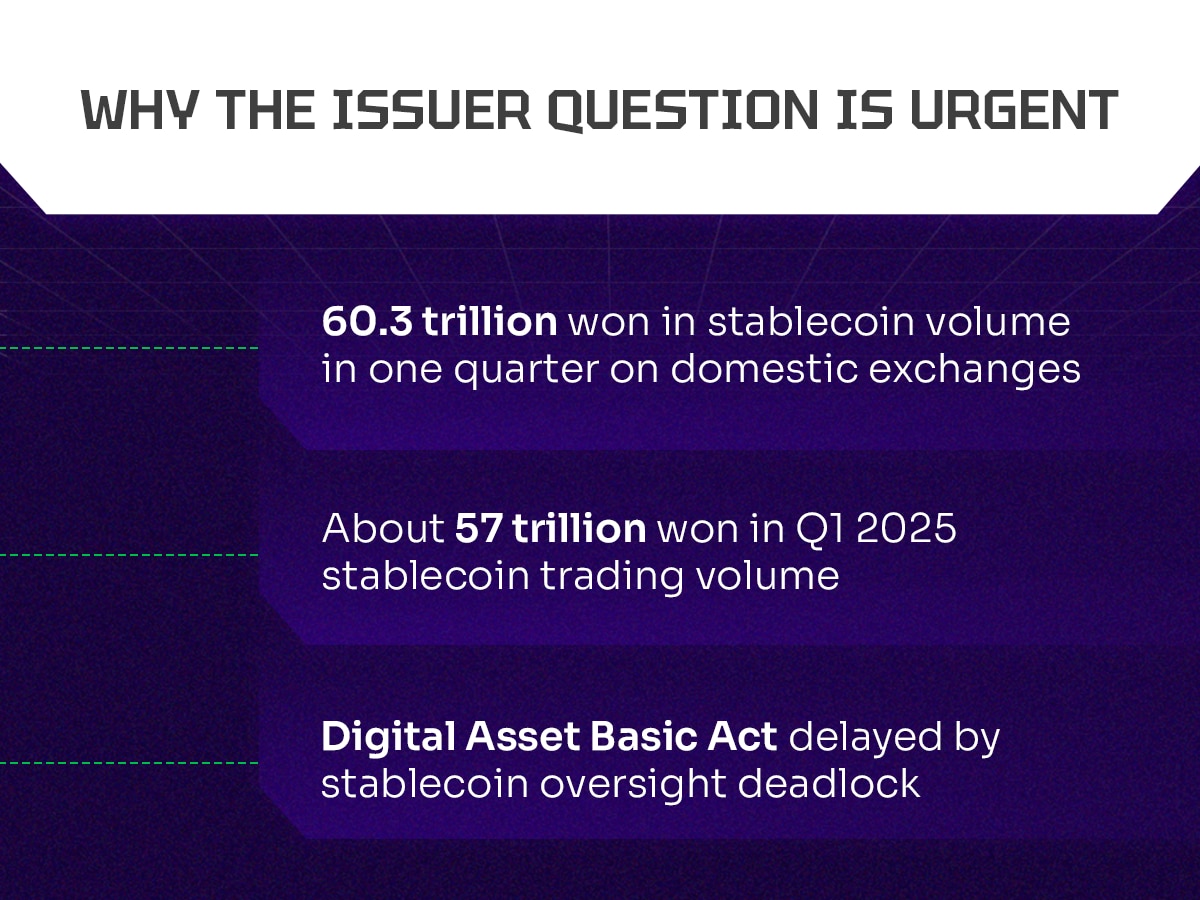
Why this debate matters beyond one law
What is unfolding in South Korea is not unique to one bill or one asset class. The debate over South Korea’s stablecoin regulation highlights a broader tension regulators everywhere are facing: markets move faster than lawmaking, and enforcement alone cannot keep pace.
For Web3 and fintech, this exposes the limits of process-driven compliance. Checklists, disclosures, and reviews rely on clarity arriving later. In periods of regulatory uncertainty, those tools offer little protection.
That is why architecture matters more than process. Systems that apply rules upfront through design, permissions, and controls are better suited to operate when regulation lags. This moment shows that in the absence of clarity, system design carries more regulatory weight.
What this South Korea crypto law update signals ahead
The debate over won-pegged stablecoin issuance rules shows how regulation is being reworked, not abandoned. Questions like who can issue stablecoins in South Korea are still open, and the Digital Asset Basic Act delay South Korea makes clear that resolution will take time.
“As we are in the initial stage of designing the system, we recognise the importance of incorporating sufficient safeguards and are meticulously reviewing it with relevant ministries.”
— FSC Chairman Lee Eun-won, on the careful regulatory design process.
However, that does not stop activity; rather, it changes how responsibility is handled. As enforcement and rulemaking move slowly, more of the burden shifts into how systems are designed and governed.
