


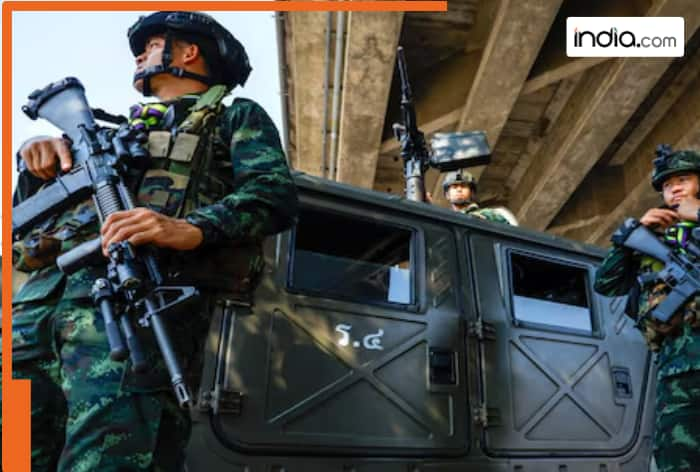
For the past four years, Myanmar has been caught in a brutal civil war, with the military junta and various rebel groups locked in an intense battle for control. The conflict began when Myanmar’s military, led by General Min Aung Hlaing, overthrew Aung San Suu Kyi’s government over allegations of election fraud. This sparked massive protests and later escalated into a full-scale armed rebellion.
Today, the junta is losing its grip on power, facing fierce resistance from groups like the People’s Defense Forces (PDF), the Arakan Army, the Kachin Independence Army, and the Karen National Union. As the fighting intensifies, India and other neighboring countries are watching closely, weighing their interests in the region.
For India, Myanmar’s instability presents serious geopolitical and security concerns. China has been playing a double game—on one hand, supporting the military junta, while on the other, providing aid to ethnic rebel groups to secure its economic and strategic interests. Given China’s heavy investments in Myanmar, it wants to maintain influence, no matter which side prevails.
Meanwhile, the United States is also looking to expand its control in the region, making the situation even more complex. Additionally, Bangladesh has a stake in Myanmar’s future.
India has invested in key infrastructure projects in Myanmar, many of which are now under threat due to the ongoing war. Projects like the Kaladan Multimodal Transit Transport Project and the India-Myanmar-Thailand Trilateral Highway are crucial for regional connectivity and trade.
Beyond economic concerns, India also has serious security challenges—border instability, insurgent activities, and China’s growing presence in Myanmar. Given these risks, India needs a careful and strategic approach to protect its investments, security, and influence in the region.
The United States is actively working to expand its influence in South Asia, aiming to shape the political landscape in Myanmar and Bangladesh to counter China’s growing dominance. Additionally, the U.S. does not want India to rise too quickly in the region.
Reports suggest that Washington is promoting Christian influence in Myanmar’s Chin State and India’s Manipur and Mizoram. At the same time, radical Islamic ideologies are gaining ground in Bangladesh, leading to increasing attacks on liberal voices.
India is deeply concerned about the evolving situations in Myanmar and Bangladesh, but it is avoiding direct military intervention. Instead, India is working closely with the US., Saudi Arabia, and the UAE to restore secularism in Bangladesh and counter growing Chinese influence in Myanmar. Securing its Northeastern states remains a top priority for New Delhi.
According to experts, India should establish discreet ties with Myanmar’s rebel groups to stay informed and protect its interests. Intelligence operations could play a key role in gathering insights. However, direct military action might backfire, harming India’s long-term goals.
The best way forward for India is to pursue diplomatic and strategic negotiations, working alongside regional and global powers to ensure stability while safeguarding its interests in Myanmar and Bangladesh.





For breaking news and live news updates, like us on Facebook or follow us on Twitter and Instagram. Read more on Latest World News on India.com.