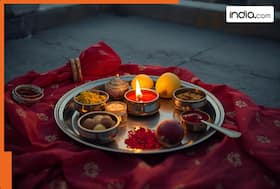
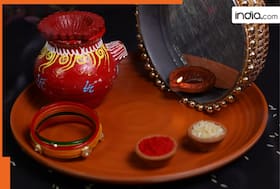
Karva Chauth is a festival celebrated by the Hindu women in many countries. In this one day festival, the married women fast from sunrise to moonrise for the long life of their husbands. Karwachauth falls on the 4th day after the full moon, in the month of Kartik, as per the Hindu calendar. Sometimes, the unmarried women also fast for their fiancés or desired husbands. A similar festival is known as Chhath and is observed in Madhya Pradesh, Jharkhand, Chhattisgarh and Western Bihar. Women start the preparation of Karwachauth a few days in advance. They buy cosmetics, jewellery, and puja items, such as the Karva lamps, mehendi, matthi, and the decorated puja thali. On the day of the fast, women wake up to eat and drink just before sunrise. Women eat soot feni with milk in sugar. It is said that this helps them go without water the next day. The mother-in-law gives sargi to the daughter-in-law. Sargi is an important part of Karwachauth. The fast commences with dawn. The women do not eat or drink the entire day. Women apply mehendi and other cosmetics. In some parts of the nation, it is customary to give and exchange painted clay pots filled with put bangles, home-made candy, ribbons, cosmetics and handkerchiefs. Since Karva Chauth follows after the Kharif crop harvest, it is a good time for the community festiivities. Married daughters get gifts from their parents.
The community women-only ceremony is held in the evening. The married women dress up beautifully in vibrant colors. In Uttar Pradesh, women wear lehengas or saris. Women sit in a circle with their puja thalis. The story of Karwachauth is narrated with regular pauses. The Karva Chauth song is sung and women pass their thalis around in the circle. For the first six rounds, women sing ‘Veero kudiye Karvara, Sarv suhagan Karvara, Aye katti naya teri naa, Kumbh chrakhra feri naa, Aar pair payeen naa, Ruthda maniyen naa, Suthra jagayeen naa, Ve veero kuriye Karvara, Ve sarv suhagan Karvara’. For the seventh round, the women sing ‘Veero kudiye Karvara, Sarv suhagan Karvara, Aye katti naya teri nee, Kumbh chrakhra feri bhee, Aar pair payeen bhee, Ruthda maniyen bhee, Suthra jagayeen bhee, Ve veero kuriye Karvara, Ve sarv suhagan Karvara.’ Women exchange Karvas seven times between themselves. In the Rajasthan state, before offering water seven times the fasting woman is asked "Dhapi ki Ni Dhapi?" (are you satiated?). The women responds, “Jal se Dhapi, Suhaag se na Dhapi" (I am satiated by water, but not from [love of] my husband). In Uttar Pradesh, an elderly woman of the family narrates the story of beejabeti or Veervati and sings ‘Sadaa suhagan karve lo, Pati ki pyari karve lo, Saat bhaiyon ke behen karve lo, Vart karni karve lo, Saas ki pyaari karve lo’. The fasters offer baayna to the mansana and give it to their mother-in-law.
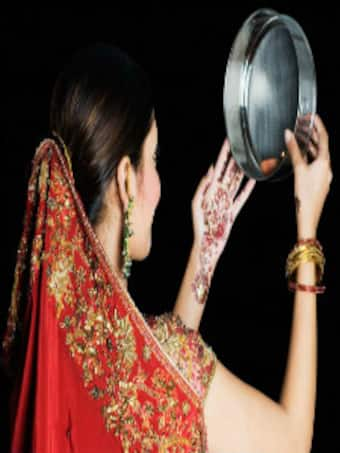
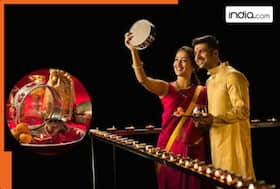
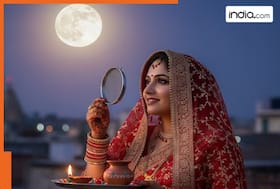
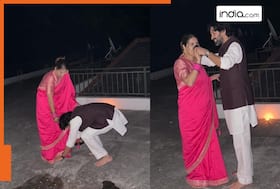
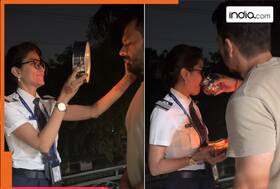
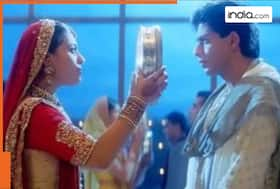
After the rounds ceremony, women await for the moon to rise. After the moon is visible, the fasting woman, with her husband nearby offer arka to the moon to get its blessings. She then turns to her husband and touches his feet. In Rajasthan the women say "Like the gold necklace and the pearl bracelet, just like the moon may my suhaag always shine brightly." A beautiful queen named Veervati was a sister of seven brothers. She fasted in her first Karva Chauth after sunrise. By evening, she was eagerly waiting for the moonrise. She is extremely thirsty and famished. Her brothers couldn't see her in hunger and thirst and created a mirror in a pipal tree and lied that the moon has risen. Veervati mistook it for the moon and broke her fast. Soon after, her husband died. She got sad and the Goddess appeared to reveal how she had been tricked by her brothers. She was asked by the Goddess to repeat her fast with complete devotion. When Veervati repeated the fast, Yama was forced to bring back her husband to life.
In the year 2016, Karwachauth is falling on October 19. Women are preparing for the eve from many days in advance. They will wake up in the dawn and have sargi. Then will fast for the entire day and will open the fast in the evening after the moon rise.
 English