


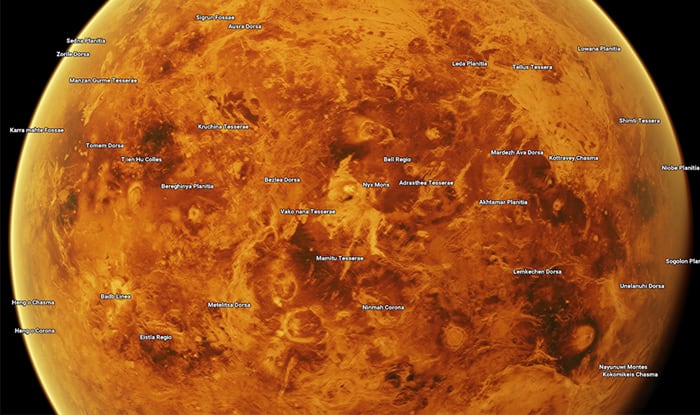
Google has announced and made new improvements to its Google Maps which allows the user to to explore other neighbouring planets and moons in our solar system using the navigation app. Google Maps has added Mercury, Venus, Mars, Earth, International Space Station, Pluto, Moon, Ceres, Io, Europa, Ganymede, Mimas, Enceladus, Dione, Rhea, Titan and Iapetus. To access and view the menu for the other planets, the users just have to zoom out from the Earth and select the satellite view. The maps were created using multiple photographs of the celestial bodies and they are not as detailed as the maps of the Earth but they do give a pretty clear view about the celestial body. When you zoom out from the Earth, there is no particular guideline to look for a particular location however, clicking on any map entry provides additional information about the place like type, size and etymology of the name.
Through this Google Maps feature we can visit our neighbouring planets in the solar system and also look at the different satellites of Saturn such as Enceladus, Dione or Iapetus, Rhea and Mimas as well as Jupiter’s Europa and Ganymede. In a blogpost on Monday, Stafford Marquardt, Product Manager at Google, said, “Explore the icy plains of Enceladus, where Cassini discovered water beneath the moon’s crust-suggesting signs of life. Peer beneath the thick clouds of Titan to see methane lakes.” He further added, “We’ve added Pluto, Venus, and several other moons for a total of 12 new worlds for you to explore.”

Source: Google Maps
This new addition of Google Maps is an awesome feature because looking at Earth revolving on its axis and showing the day and night difference in space amidst millions of stars is a surreal experience. Also, looking at Mercury, Venus and mars up, close and personal makes this an amazing experience. It feels as if you’re transported to the edge of space and are about to circle the planet or make your landing on its surface. The International Space Station can also be visited through Google Maps, which also joined the Google’s Street View program. The company stated that it worked closely with astronomical artist Bjorn Jonsson who helped assemble the maps of planets and moons to the specification of Google Maps, he took the imagery from US Space Agency NASA and the European Space Agency.

For breaking news and live news updates, like us on Facebook or follow us on Twitter and Instagram. Read more on Latest Viral News on India.com.
