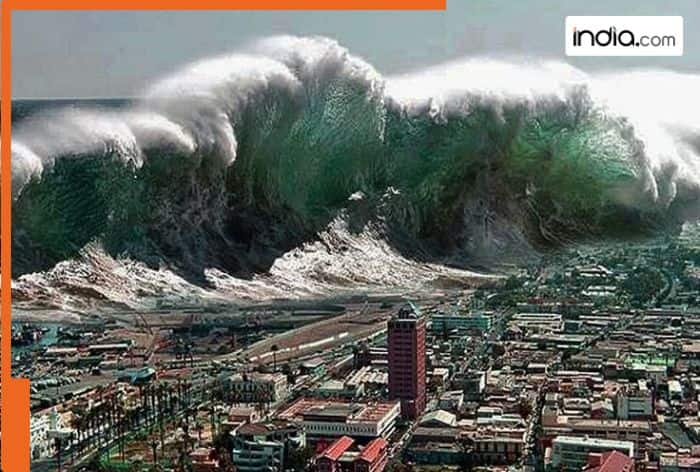
Understanding seiches and tsunamis
When people hear about huge waves, they often think of tsunamis, the massive waves usually caused by underwater earthquakes, volcanic eruptions, or landslides. These waves travel across oceans at high speeds and can be extremely destructive when they reach the shore.
But what happened in Greenland’s Dickson Fjord in 2023 was a bit different. It wasn’t a regular tsunam, it was something called a seiche.
What’s the Difference?
- A tsunami is a wave that moves outwards after something suddenly moves a lot of water—like when part of the sea floor shifts.
- A seiche, on the other hand, happens in enclosed or semi-enclosed bodies of water like lakes or fjords. The water rocks back and forth like it does in a bathtub when you shake it.
In Dickson Fjord, the shape of the narrow valley kept the waves trapped after a massive chunk of rock and ice fell into the water. The waves could not travel away like a tsunami, so they kept bouncing back and forth, creating a rhythmic motion that lasted for days. This movement sent low-frequency vibrations deep through the Earth.
How scientists solved the mystery
To figure out what caused these odd signals, scientists turned to technology using satellites and artificial intelligence.
The main tool was a new satellite called SWOT (Surface Water and Ocean Topography), launched in December 2022 by NASA and the French space agency. Unlike older satellites that only scanned narrow paths, SWOT uses Ka-band Radar Interferometer (KaRIn) to capture wide, high-resolution images of water surfaces.
When scientists looked at SWOT data from Greenland, they saw the surface of the water in the fjord was slightly tilted by as much as 2 metres. These subtle rises and falls matched the movement expected from a seiche.
To understand the event even better, researchers used machine learning (a type of AI) to simulate how the waves might behave over time. They also checked data from:
- Ground sensors far away
- Weather patterns
- Tide changes
To prove their theory, the researchers linked these observations to small movements of the Earth’s crust measured thousands of kilometres away. This connection enabled them to reconstruct the characteristics of the wave, even for periods that the satellite did not observe. The researchers also reconstructed weather and tidal conditions to confirm that the observations could not have been caused by winds or tides.
The findings were published Tuesday (June 3) in the journal Nature Communications. The fjord’s unique geography trapped the tsunami’s energy, preventing it from dissipating quickly.