


India.com News Desk
The India.com News Desk cover breaking stories from around the world. The desk works 24/7 to bring latest news related to national and international politics, business and education. ... Read More


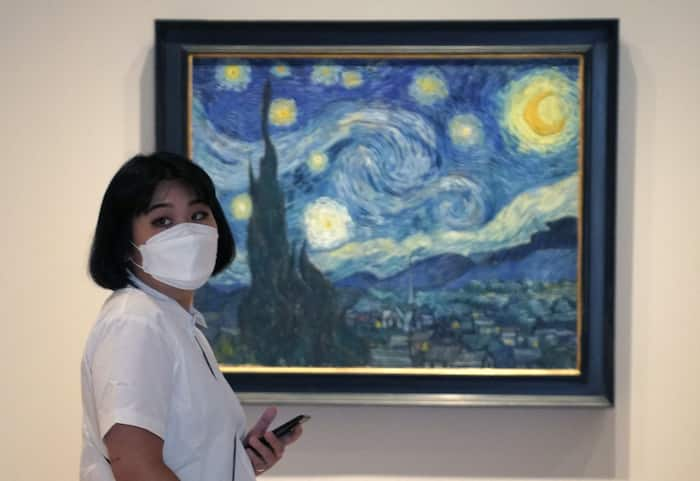
New Delhi: Dutch Post-Impressionist painter Vincent Van Gogh’s masterpiece ‘The Starry Night’ is arguably one of the world’s most recognized pieces of art. But did you know that this historic piece of art has an Indian connection? Painted in 1889, the painting is an imaginary view from a lonely window of Saint-Paul Asylum in Southern France, where Van Gogh was lodged when he painted it.
The mid-scale, oil-on-canvas painting is dominated by a moon- and the star-filled night sky and is available for public viewing at the Museum of Modern Art (MoMA) in New York. ‘The Starry Night’ is packed with bright orbs—including the crescent moon to the far right, and the morning star, to the left of center—surrounded by concentric circles of radiant white and yellow light. Among the swirling celestials, the moon stands out in the painting because of its bright yellow colour , specifically the ‘Indian Yellow’, which is used in its original form in the painting.
As Holi celebrations continue, we retrace the bewildering journey of a color from a Bihar village to one of the world’s most celebrated paintings. A thread (1/n) pic.twitter.com/FhOSeVjvba
— The Paperclip (@Paperclip_In) March 19, 2022
The famed ‘Indian Yellow’ has been used in the colourart for centuries. The deep yellow of the moon in ‘The Starry Night’ employed a blend of the rare Indian yellow pigment and zinc yellow, as per ColourLex.
The Indian yellow is a strong luminescent pigment used by many European artists for its tinting properties, but as the name suggests, it was an exotic import from India. It was also used by British artists heavily to color native subjects (5/n)
— The Paperclip (@Paperclip_In) March 19, 2022
Looking back at the history of vibrant colour, BBC in a report explored the cruel lenage behind the manufacturing of the pigment. According to a BBC report, the Indian Yellow was created by the urine of wasting cows, who were allegedly force-fed nothing other than mango leaves in the then Bengalese city of Monghyr (currently Munger in Bihar).
The color was imported to Europe and was used by various renowned western painters, especially in Northern Europe, since the Dutch merchants had a deep association with India. Vincent van Gogh was the most famous of them to use Indian Yellow (7/n)
— The Paperclip (@Paperclip_In) March 19, 2022
The cow’s urine was reputedly caught in terracotta pots and clarified to a syrup over an open flame. The syrup was then filtered, dried, and clenched into pigment clumps called ‘piuri’ that were then sold as chalky spheres. The priced Yellow pigment was then imported to Europe and was once part of the palettes of every artist from Turner to Van Gogh.
Recently, on the occassion of Holi, a twitter handle ‘The Paperclip’ traced the history of the pigment and how it foundit’s way into one of world’s most famous work of art.
